

Since 2005, we have been transforming academic knowledge into innovative solutions for the environmental and industrial challenges facing Brazil and Latin America.
PAM Membranas Seletivas is a Brazilian technology-based company headquartered at the Federal University of Rio de Janeiro (UFRJ) Technology Park. Originally a spin-off from the COPPE/UFRJ Membrane Separation Processes Laboratory, the company brings together more than five decades of scientific knowledge applied to the development of solutions based on membrane technology.
Recognized for its pioneering role in Latin America in the manufacture of microfiltration and ultrafiltration membranes and modules, PAM is active in the design, manufacture, and operation of systems for water and wastewater treatment, as well as various industrial applications related to the separation and concentration of components. Its products combine technological innovation, operational reliability, and technical rigor, serving various market segments.
With a focus on custom engineering, PAM develops tailor-made projects that take into account the specific characteristics of each application, always committed to offering efficient, sustainable solutions that meet its customers’ needs.

It began as a spin-off from the COPPE/UFRJ membrane laboratory and was the first company in Latin America to produce hollow-fiber membranes.

Consolidation of the company and relocation to the UFRJ Technology Park, expanding its operations to include the development of equipment using advanced membrane technologies.
We strengthened our partnership with Petrobras and began full-scale operation of the system.

First ultrafiltration system exported (Paraguay).

National recognition through the Petrobras Connections Award for technological innovation.

Honorable Mention from SEBRAE Rio at the 2024 Visão Consciente Awards.

Participation in Green Rio 2025, contributing to discussions on sustainability and innovation in membrane technologies.
Our team consists of technicians, engineers, and professionals with master’s and doctoral degrees who have extensive experience in membrane separation processes. We specialize in the design, sizing, manufacturing, and operation of membrane systems, with a focus on performance, reliability, and adaptation to actual operating conditions.
The team conducts bench tests, pilot-scale tests, and field validations, ensuring that each solution is technically sound, customized, and focused on industrial results.
To develop, manufacture, and implement membrane technology solutions that promote operational efficiency, innovation, and sustainability, applying the scientific and technological knowledge developed in the academic environment to solve real-world industrial problems through customized projects characterized by technical excellence and reliability.
To be a national leader in membrane separation technologies, distinguished by continuous innovation, the quality of its products and services, and its contribution to the transition toward more efficient and environmentally responsible industrial processes.
Operate with scientific rigor, high-quality engineering, and a focus on performance and reliability.
To transform academic and technological knowledge into practical and competitive solutions.
To contribute to the rational use of water, the reduction of environmental impacts, and the efficient use of resources.
Develop customized solutions tailored to the specific needs of each application.
Conduct relationships with integrity, responsibility, and respect.
Operate with technical responsibility and a focus on long-term performance, ensuring reliability throughout the entire life cycle of our solutions.
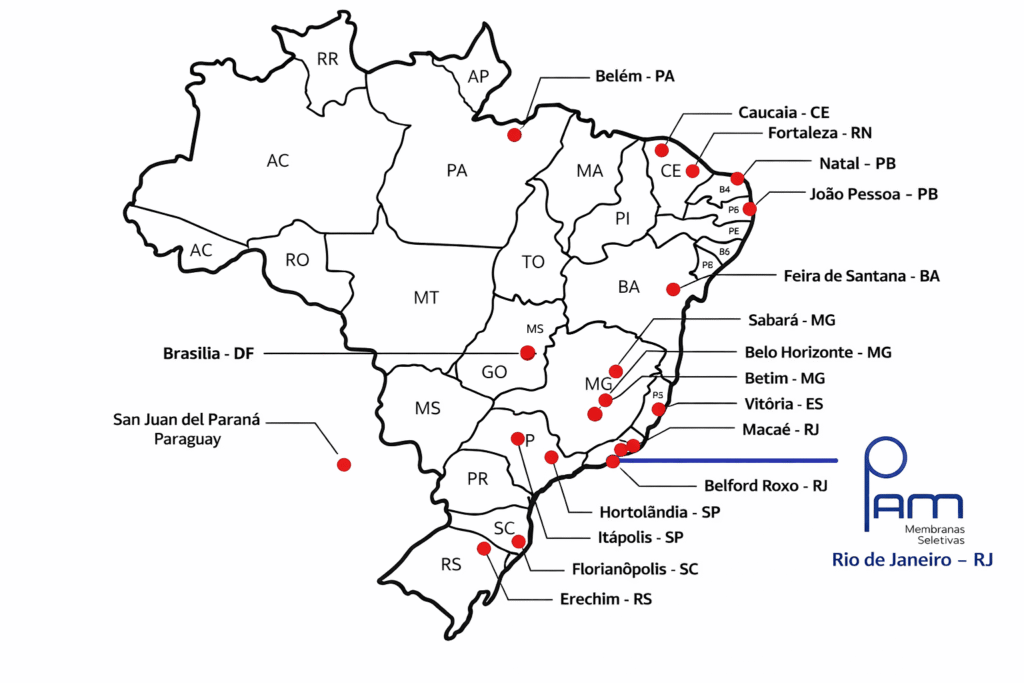
PAM Membranas operates in various regions of Brazil and Latin America, with equipment and systems installed in industrial facilities, universities, research centers, and wastewater treatment plants.
Our operations, which span Brazilian states and extend into Paraguay (San Juan del Paraná), reinforce our technical expertise and ability to meet a variety of industrial needs on an international scale.
Because we understand your challenge and turn it into a solution.
Using technology developed at COPPE/UFRJ, we provide you with high-performance membranes and smart systems, custom-designed to meet your needs.
Here, you'll find:
☑️ Customized solutions
☑️ Specialized technical knowledge
☑️ Superior long-term value for money
☑️ Continuous and reliable support
We don't just sell products; we deliver results that make a real difference.
👉 At PAM, we believe that every client deserves a customized solution. That’s why we work side by side with you to ensure consistent and sustainable results.
A Brazilian company specializing in membrane separation processes, a pioneer in the production of hollow fibers in Latin America, and a leader in applied engineering for microfiltration, ultrafiltration, nanofiltration, and reverse osmosis.
CHARACTERISTICS OF HOLLOW ULTRAFILTRATION FIBERS:
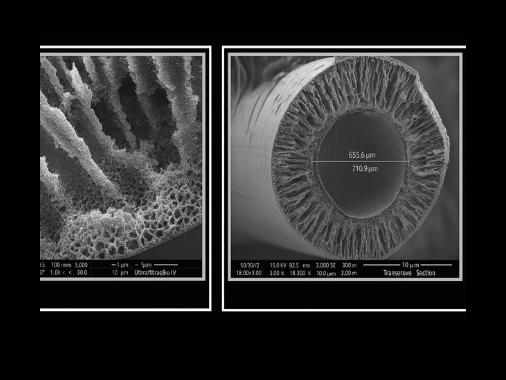
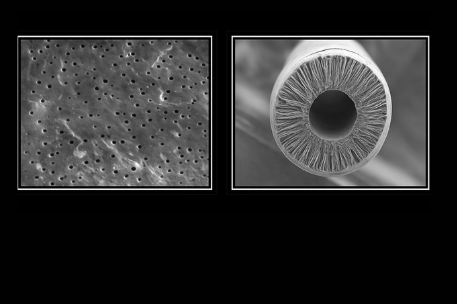
a) Membranes with a cylindrical geometry, of the hollow-fiber type (Figure 1);
b) Material of the hollow fibers: poly(ether sulfone);
c) Outer diameter of the fibers: between 0.8 and 0.9 mm;
d) Fibers with a selective outer layer;
e) UF fibers exhibit 95.0% effective retention for compounds with a molecular weight greater than 50 kDa;
f) Filtration occurs from the outside to the inside of the fibers;
g) The ultrafiltrated extract flows through the interior of the fibers;
h) Module construction material: weldable PVC;
i) Operating pressure: depends on the extract to be processed in the equipment. The critical pressure for each type of extract must be determined;
j) Maximum operating pressure: 5 bar;
l) Maximum operating temperature: up to 55.0°C;
m) pH: 2.0 to 13.0.
CHARACTERISTICS OF HOLLOW MICROFILTRATION FIBERS:
a) Membranes with a cylindrical geometry, of the hollow-fiber type;
b) Material of the hollow fibers: poly(imide);
c) Outer diameter of the fibers: between 0.9 and 1.0 mm;
d) Fibers with a selective outer layer;
e) Average pore size on the outer surface of the fibers: 0.4 µm (Figure 1);
f) Retention of 99.99% of the microorganisms and suspended solids present in the extract to be processed;
g) Filtration occurs from the outside to the inside of the fibers;
h) The microfiltrate flows through the interior of the fibers;
i) Operating pressure: dependent on the stream to be processed by the equipment. The critical pressure for each type of feed stream must be determined;
j) Maximum operating pressure: 5 bar;
l) Maximum operating temperature: up to 55.0°C;
m) pH: 2.0 to 13.0.
Devices that use a membrane to create a large contact area between two phases (gas-liquid) without allowing them to disperse.
One phase flows through one side of the membrane and the other through the other side. Mass transfer occurs through the pores without the phases mixing.
Water degassing (removal of O2 and CO2), carbonation of beverages, liquid-liquid extraction without emulsification.
A process for separating liquid mixtures in which the permeate is removed as vapor; effective for azeotropic mixtures.
A component preferentially permeates through the membrane and evaporates on the permeate side, which is maintained under vacuum.
Solvent dehydration (ethanol, isopropanol), removal of volatile organic compounds (VOCs) from water, separation of organic-organic mixtures.
The process with the highest rejection capacity. It removes virtually all dissolved salts and contaminants, producing water of the highest purity.
It applies pressure greater than the solution's osmotic pressure, forcing water to pass through the membrane in the opposite direction of the natural flow, leaving the salts behind.
Seawater desalination, production of ultrapure water for industries (pharmaceutical, semiconductor), and purification of water for consumption.
An intermediate process between UF and reverse osmosis, with pore sizes ranging from 1 to 10 nanometers. It removes multivalent ions (hardness) and low-molecular-weight organic molecules.
It operates at higher pressures than UF. It separates components based on size and electric charge, allowing monovalent ions to pass through.
Water softening, partial desalination, pesticide removal, wastewater recycling.
Similar to microfiltration, but with smaller pores (0.01 to 0.1 micrometer), capable of retaining viruses and macromolecules such as proteins.
It uses hydrostatic pressure to force the solvent through the membrane, while high-molecular-weight solutes are retained.
A membrane separation process that removes suspended particles, bacteria, and colloidal solids in the range of 0.1 to 10 micrometers. It operates at low pressures.
Water or a fluid is forced to pass through a microporous membrane. Particles larger than the pores are retained on the surface of the membrane.
✅ High flow rate
✅ Low energy consumption
✅ Effective removal of bacteria
✅ Easy to use