

Widely used in industrial, environmental, and research processes, nanofiltration is ideal for fine-tuning quality, partial demineralization, solute concentration, and as an intermediate step between ultrafiltration and reverse osmosis, ensuring greater process control and performance.
Membrane nanofiltration (NF) is a pressure-driven separation process that uses membranes with pores in the nanometer range, capable of selectively retaining multivalent ions, low-molecular-weight organic compounds, and macromolecules, while allowing monovalent salts to pass through partially.
This process occupies an intermediate position between ultrafiltration (UF) and reverse osmosis (RO), and is widely used when it is necessary to adjust the chemical composition of liquid streams, reduce hardness, remove specific contaminants, or concentrate components of interest, with lower energy consumption compared to RO.
Nanofiltration is used both as a primary treatment and as a complementary or polishing step in industrial, environmental, and research processes, offering high selectivity control, operational efficiency, and application flexibility.
Membrane nanofiltration is suitable for applications that require chemical selectivity, control of water composition, or the separation of specific contaminants, and is widely used in the following scenarios:
Membrane nanofiltration offers significant technical benefits for processes that require selectivity, energy efficiency, and water quality control, and stands out for:
PAM Membranas Seletivas develops and implements nanofiltration systems in various configurations, designed to meet the specific requirements of each process.
These solutions are designed based on a detailed technical analysis of the process stream, the customer’s objectives, and operating conditions, ensuring high performance, reliability, and energy efficiency.
At PAM, nanofiltration is not treated as a standalone piece of equipment, but as a strategic part of the process, designed to deliver selectivity, efficiency, and operational sustainability.
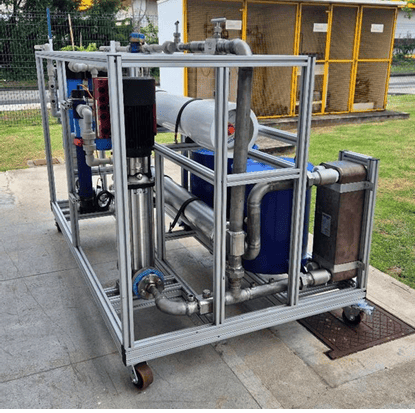
Pilot system for evaluating the performance of nanofiltration (NF) and reverse osmosis (RO) membranes, designed for testing standard spiral-wound modules (4040 and 8040), enabling precise analysis of flow rate, rejection, and operational behavior.
Nanofiltration equipment designed for realistic simulation of industrial processes, with comprehensive monitoring of critical parameters such as pressure, flow, and conductivity, ensuring reliable validation of membranes and processes.
Before implementation on an industrial scale, PAM conducts bench-scale or pilot-scale nanofiltration tests, simulating actual operating conditions.
This allows for:
Each nanofiltration system is designed in accordance with:
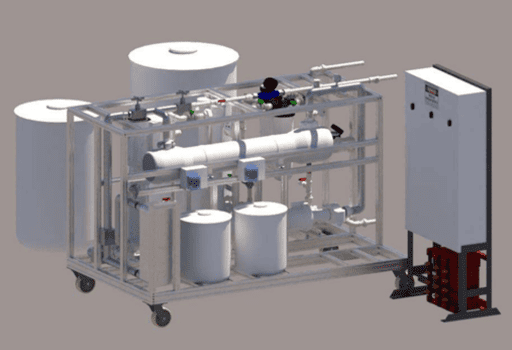
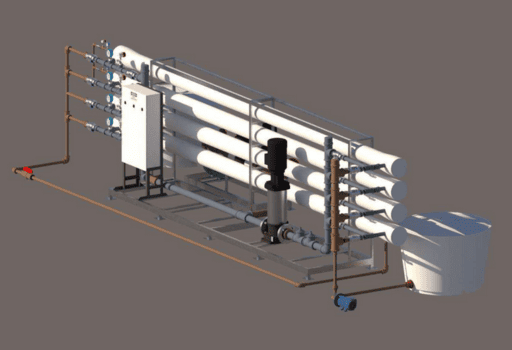
PAM develops compact, modular, and customized skids that are ready for on-site installation.
PAM conducts technical performance evaluations of NF membranes, analyzing:
Ensuring a longer service life and greater operational stability for the system.
PAM provides the following with its nanofiltration systems:
Ensuring consistent performance over time.
For strategic or critical applications, PAM can take over partial or full operation of the nanofiltration system, including:
Ensuring operational stability and technical reliability.
At PAM, nanofiltration is treated as a strategic part of the industrial process, designed to provide selectivity, energy efficiency, and long-term sustainable performance.
👉 Talk to a PAM expert and develop the ideal solution for your industrial process.
Membrane nanofiltration solutions for the selective removal of multivalent ions, hardness reduction, industrial wastewater treatment, and process optimization using custom-designed systems.
CHARACTERISTICS OF HOLLOW ULTRAFILTRATION FIBERS:
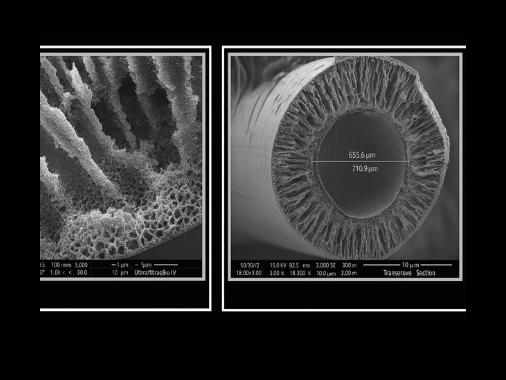
a) Membranes with a cylindrical geometry, of the hollow-fiber type (Figure 1);
b) Material of the hollow fibers: poly(ether sulfone);
c) Outer diameter of the fibers: between 0.8 and 0.9 mm;
d) Fibers with a selective outer layer;
e) UF fibers exhibit 95.0% effective retention for compounds with a molecular weight greater than 50 kDa;
f) Filtration occurs from the outside to the inside of the fibers;
g) The ultrafiltrated extract flows through the interior of the fibers;
h) Module construction material: weldable PVC;
i) Operating pressure: depends on the extract to be processed in the equipment. The critical pressure for each type of extract must be determined;
j) Maximum operating pressure: 5 bar;
l) Maximum operating temperature: up to 55.0°C;
m) pH: 2.0 to 13.0.
CHARACTERISTICS OF HOLLOW MICROFILTRATION FIBERS:
a) Membranes with a cylindrical geometry, of the hollow-fiber type;
b) Material of the hollow fibers: poly(imide);
c) Outer diameter of the fibers: between 0.9 and 1.0 mm;
d) Fibers with a selective outer layer;
e) Average pore size on the outer surface of the fibers: 0.4 µm (Figure 1);
f) Retention of 99.99% of the microorganisms and suspended solids present in the extract to be processed;
g) Filtration occurs from the outside to the inside of the fibers;
h) The microfiltrate flows through the interior of the fibers;
i) Operating pressure: dependent on the stream to be processed by the equipment. The critical pressure for each type of feed stream must be determined;
j) Maximum operating pressure: 5 bar;
l) Maximum operating temperature: up to 55.0°C;
m) pH: 2.0 to 13.0.
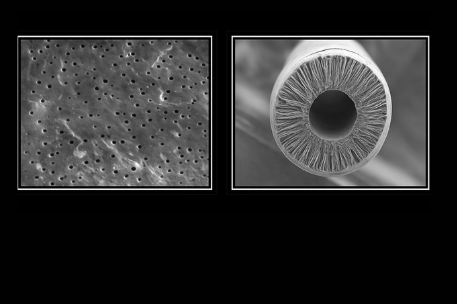
Devices that use a membrane to create a large contact area between two phases (gas-liquid) without allowing them to disperse.
One phase flows through one side of the membrane and the other through the other side. Mass transfer occurs through the pores without the phases mixing.
Water degassing (removal of O2 and CO2), carbonation of beverages, liquid-liquid extraction without emulsification.
A process for separating liquid mixtures in which the permeate is removed as vapor; effective for azeotropic mixtures.
A component preferentially permeates through the membrane and evaporates on the permeate side, which is maintained under vacuum.
Solvent dehydration (ethanol, isopropanol), removal of volatile organic compounds (VOCs) from water, separation of organic-organic mixtures.
The process with the highest rejection capacity. It removes virtually all dissolved salts and contaminants, producing water of the highest purity.
It applies pressure greater than the solution's osmotic pressure, forcing water to pass through the membrane in the opposite direction of the natural flow, leaving the salts behind.
Seawater desalination, production of ultrapure water for industries (pharmaceutical, semiconductor), and purification of water for consumption.
An intermediate process between UF and reverse osmosis, with pore sizes ranging from 1 to 10 nanometers. It removes multivalent ions (hardness) and low-molecular-weight organic molecules.
It operates at higher pressures than UF. It separates components based on size and electric charge, allowing monovalent ions to pass through.
Water softening, partial desalination, pesticide removal, wastewater recycling.
Similar to microfiltration, but with smaller pores (0.01 to 0.1 micrometer), capable of retaining viruses and macromolecules such as proteins.
It uses hydrostatic pressure to force the solvent through the membrane, while high-molecular-weight solutes are retained.
A membrane separation process that removes suspended particles, bacteria, and colloidal solids in the range of 0.1 to 10 micrometers. It operates at low pressures.
Water or a fluid is forced to pass through a microporous membrane. Particles larger than the pores are retained on the surface of the membrane.
✅ High flow rate
✅ Low energy consumption
✅ Effective removal of bacteria
✅ Easy to use