

CHARACTERISTICS OF HOLLOW ULTRAFILTRATION FIBERS:
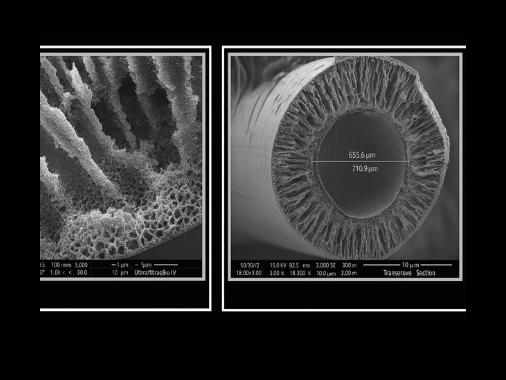
a) Membranes with a cylindrical geometry, of the hollow-fiber type (Figure 1);
b) Material of the hollow fibers: poly(ether sulfone);
c) Outer diameter of the fibers: between 0.8 and 0.9 mm;
d) Fibers with a selective outer layer;
e) UF fibers exhibit 95.0% effective retention for compounds with a molecular weight greater than 50 kDa;
f) Filtration occurs from the outside to the inside of the fibers;
g) The ultrafiltrated extract flows through the interior of the fibers;
h) Module construction material: weldable PVC;
i) Operating pressure: depends on the extract to be processed in the equipment. The critical pressure for each type of extract must be determined;
j) Maximum operating pressure: 5 bar;
l) Maximum operating temperature: up to 55.0°C;
m) pH: 2.0 to 13.0.
CHARACTERISTICS OF HOLLOW MICROFILTRATION FIBERS:
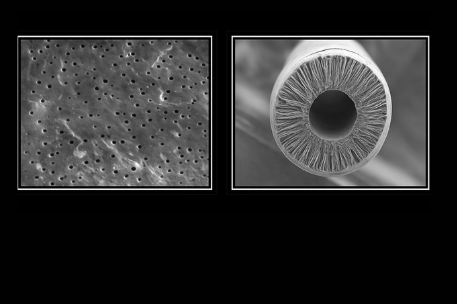
a) Membranes with a cylindrical geometry, of the hollow-fiber type;
b) Material of the hollow fibers: poly(imide);
c) Outer diameter of the fibers: between 0.9 and 1.0 mm;
d) Fibers with a selective outer layer;
e) Average pore size on the outer surface of the fibers: 0.4 µm (Figure 1);
f) Retention of 99.99% of the microorganisms and suspended solids present in the extract to be processed;
g) Filtration occurs from the outside to the inside of the fibers;
h) The microfiltrate flows through the interior of the fibers;
i) Operating pressure: dependent on the stream to be processed by the equipment. The critical pressure for each type of feed stream must be determined;
j) Maximum operating pressure: 5 bar;
l) Maximum operating temperature: up to 55.0°C;
m) pH: 2.0 to 13.0.
The process with the highest rejection capacity. It removes virtually all dissolved salts and contaminants, producing water of the highest purity.
It applies pressure greater than the solution's osmotic pressure, forcing water to pass through the membrane in the opposite direction of the natural flow, leaving the salts behind.
Seawater desalination, production of ultrapure water for industries (pharmaceutical, semiconductor), and purification of water for consumption.
 Exceptional water quality Proven and reliable technology Salt rejection rate exceeding 99% Removal of all contaminants
An intermediate process between UF and reverse osmosis, with pore sizes ranging from 1 to 10 nanometers. It removes multivalent ions (hardness) and low-molecular-weight organic molecules.
It operates at higher pressures than UF. It separates components based on size and electric charge, allowing monovalent ions to pass through.
Water softening, partial desalination, pesticide removal, wastewater recycling.
Lower energy consumption than RO Preserves minerals (monovalent ions) High rejection of divalent ions Wide range of applicationsSimilar to microfiltration, but with smaller pores (0.01 to 0.1 micrometer), capable of retaining viruses and macromolecules such as proteins.
It uses hydrostatic pressure to force the solvent through the membrane, while high-molecular-weight solutes are retained.
Virus Removal Operation at low temperatures Excellent permeate quality High selectivity